Understanding the Mental and Emotional Reasons Behind Procrastination
We all procrastinate sometimes. You may have an important assignment to complete, an email to send, a household task to finish, or a difficult decision to make—and yet you find yourself scrolling through your phone, watching another video, cleaning your desk, or telling yourself, “I’ll do it later.”
But why do we procrastinate even when we know that delaying a task may create more stress later?
Procrastination is not simply about being lazy or lacking discipline. It is often connected to emotions, thoughts, motivation, stress, perfectionism, anxiety, and difficulties with executive functioning. Understanding the psychology behind procrastination can help us replace self-blame with practical strategies for change.
At Hope and Care Clinic, Barasat, psychiatrist Dr. Sanjoy Roy helps individuals understand the psychological factors that may contribute to procrastination, stress, anxiety, attention difficulties, and other mental health concerns.
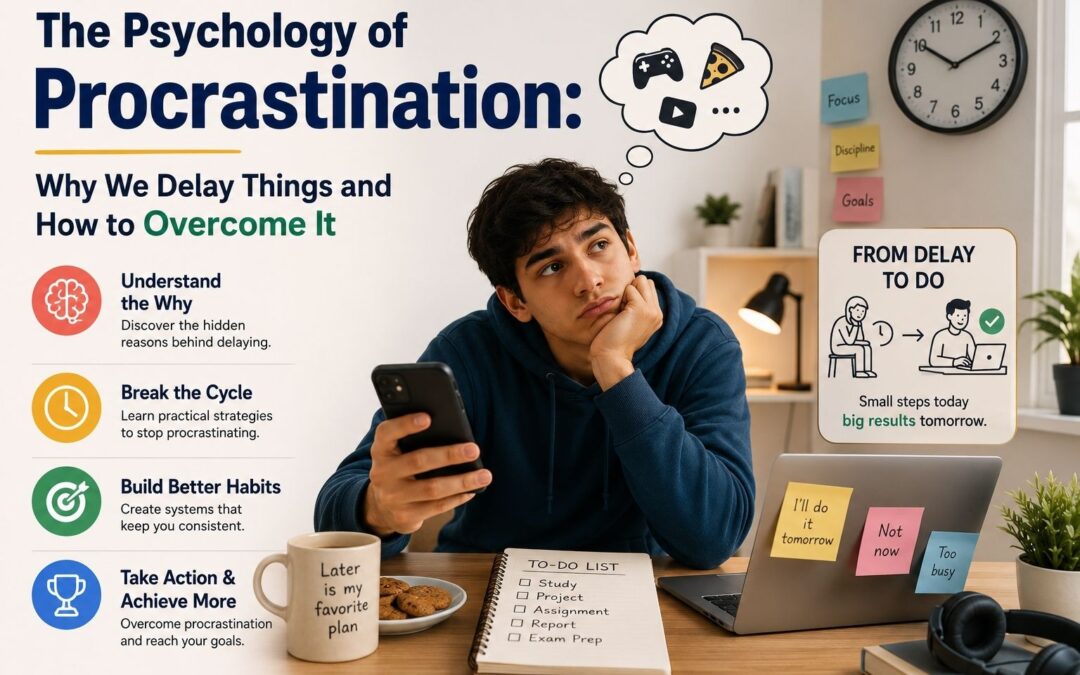
In this article, we explore why people procrastinate, the psychological causes of procrastination, how procrastination affects mental health, and practical ways to break the cycle.
What Is Procrastination?
Procrastination is the habit of unnecessarily delaying or avoiding a task despite knowing that postponing it may lead to negative consequences.
It is important to distinguish procrastination from simply taking a break or deliberately postponing something for a valid reason.
For example, taking time to rest after several hours of work is not necessarily procrastination. Procrastination occurs when you repeatedly avoid an important task even though you know you need to complete it.
Common examples include:
- Delaying work until the deadline is close
- Avoiding difficult conversations
- Putting off studying
- Ignoring emails or paperwork
- Delaying household responsibilities
- Constantly postponing exercise
- Waiting for the “right mood” to begin
- Spending excessive time on social media instead of working
Occasional procrastination is normal. However, persistent procrastination that interferes with work, education, relationships, or daily life may require closer attention.
Why Do We Procrastinate?
The psychology of procrastination is more complicated than simply saying, “I don’t feel like doing it.”
Often, procrastination is an attempt to avoid an uncomfortable emotional experience.
A task may make us feel:
- Bored
- Anxious
- Overwhelmed
- Insecure
- Frustrated
- Confused
- Afraid of failure
- Afraid of being judged
When we avoid the task, we may experience temporary relief.
That relief can reinforce the behavior.
For example:
Difficult task → anxiety → avoidance → temporary relief → task remains unfinished → more anxiety → more avoidance
This can become a repeating cycle.
Procrastination and the Brain
Completing a task often requires several executive functions, including:
- Planning
- Prioritizing
- Sustaining attention
- Controlling impulses
- Managing time
- Starting an activity
- Monitoring progress
These abilities involve several areas of the brain, including networks associated with executive functioning and emotional regulation.
Procrastination can occur when the immediate desire to avoid discomfort becomes stronger than the longer-term benefit of completing the task.
This is why someone may genuinely want to finish something but still struggle to start.
Common Psychological Causes of Procrastination
1. Fear of Failure

Fear of failure is one of the common reasons people postpone tasks.
A person may think:
“What if I can’t do it properly?”
Instead of facing the possibility of failure, they avoid starting altogether.
Unfortunately, postponing the task usually increases anxiety and makes the eventual deadline more stressful.
2. Perfectionism
Perfectionism can be closely linked with procrastination.
A person may believe:
- “It has to be perfect.”
- “I need to know everything before I start.”
- “If I can’t do it perfectly, there is no point doing it.”
These expectations can make even simple tasks feel overwhelming.
As a result, the person delays starting.
Remember: progress is often more useful than perfection.
3. Anxiety and Overwhelm
Large or complicated tasks can trigger anxiety.
For example, instead of thinking:
“I need to prepare a presentation.”
the brain may interpret the task as:
“I have to research, write, design, practice, and present everything.”
The size of the task can create a feeling of being overwhelmed, leading to avoidance.
Breaking the task into smaller steps can make it feel more manageable.
4. Lack of Motivation
Some tasks are simply boring or repetitive.
When a task provides little immediate satisfaction, it may be difficult to begin.
This is particularly noticeable when highly stimulating activities—such as social media, gaming, or entertainment—are readily available.
The brain naturally tends to be attracted to activities that provide immediate rewards.
5. Fear of Judgment
People may procrastinate because they worry about how others will evaluate their work.
This can be particularly common among students, professionals, and individuals who place significant importance on achievement.
Thoughts may include:
- “What will people think?”
- “What if they criticize me?”
- “What if everyone else is better?”
Avoiding the task temporarily protects the person from these uncomfortable thoughts.
The Connection Between Procrastination and ADHD
Procrastination can sometimes be associated with Attention-Deficit/Hyperactivity Disorder (ADHD), particularly when difficulties with executive functioning are present.
Adults with ADHD may experience challenges with:
- Starting tasks
- Time management
- Prioritizing
- Sustaining attention
- Organising responsibilities
- Estimating how long tasks will take
However, procrastination alone does not mean someone has ADHD.
If procrastination is persistent and occurs alongside significant difficulties with attention, impulsivity, organization, or time management, a professional assessment may be helpful.
Procrastination and Anxiety
Anxiety can create a powerful procrastination cycle.
A person may worry about a task, avoid it to feel better temporarily, and then experience increased anxiety because the task remains unfinished.
This can lead to:
Anxiety → avoidance → temporary relief → guilt → increased anxiety → more avoidance
Breaking this cycle often requires addressing both the practical task and the underlying emotional response.
Procrastination and Depression
Persistent procrastination can also occur alongside depression.
Depression may involve:
- Low motivation
- Fatigue
- Difficulty concentrating
- Loss of interest
- Feelings of hopelessness
- Reduced energy
When someone is experiencing these symptoms, simply telling them to “work harder” may not solve the underlying problem.
Addressing the mental health condition can be an important part of improving motivation and daily functioning.
How Procrastination Affects Mental Health
Procrastination may provide short-term relief, but repeated avoidance can create long-term problems.
Increased Stress
As deadlines approach, unfinished tasks can become a major source of stress.
Guilt and Self-Criticism
People may begin thinking:
- “Why can’t I get anything done?”
- “I’m so lazy.”
- “Everyone else can do this except me.”
Repeated self-criticism can damage confidence.
Poor Sleep
Late-night attempts to complete postponed work can interfere with sleep and create a cycle of fatigue and reduced productivity.
Reduced Productivity
Constantly delaying important tasks can make it harder to achieve academic, professional, and personal goals.
Relationship Difficulties
Repeatedly postponing shared responsibilities can sometimes create frustration and conflict within relationships.
Why “Just Be Disciplined” Doesn’t Always Work
One of the biggest misconceptions about procrastination is that it can always be solved through willpower.
Motivation and discipline are important, but persistent procrastination may involve deeper factors such as:
- Anxiety
- Perfectionism
- Low self-confidence
- ADHD-related executive functioning difficulties
- Depression
- Burnout
- Fear of failure
- Emotional avoidance
Understanding the reason behind procrastination is often more effective than simply blaming yourself for doing it.
Practical Ways to Stop Procrastinating
1. Start With Just Five Minutes
Instead of telling yourself:
“I have to finish this entire project.”
try:
“I will work on it for five minutes.”
Starting is often harder than continuing.
Once you begin, continuing may become easier.
2. Break Large Tasks Into Smaller Steps
Instead of writing:
“Complete project”
create smaller actions:
- Open the document.
- Write the title.
- Find three sources.
- Write the introduction.
- Review the first section.
Small steps reduce the feeling of being overwhelmed.
3. Use the Two-Minute Rule
If something can genuinely be completed in approximately two minutes, consider doing it immediately rather than adding it to an ever-growing task list.
This can prevent small responsibilities from accumulating.
4. Reduce Distractions
Make the desired behavior easier and distractions harder.
Try:
- Turning off unnecessary notifications
- Keeping your phone away while working
- Closing unrelated browser tabs
- Working in a quiet environment
Your environment can strongly influence your behaviour.
5. Use Time Blocks
Instead of expecting yourself to work continuously for hours, divide your day into manageable work periods.
For example:
25 minutes of focused work → short break → repeat
The exact duration can be adjusted according to your needs.
6. Set Realistic Goals
Unrealistic expectations can encourage avoidance.
Instead of planning to complete ten major tasks in one day, identify the two or three most important priorities.
Achievable goals create a greater sense of progress.
7. Stop Waiting for Motivation
A common mistake is waiting until you “feel motivated” before starting.
In many cases, action comes before motivation.
Starting a small part of the task can create momentum and make the next step easier.
8. Practice Self-Compassion
Beating yourself up over procrastination can make the problem worse.
Instead of:
“I’m useless because I procrastinated again.”
try:
“I avoided this because it felt difficult. What is one small step I can take now?”
Self-compassion does not mean ignoring responsibility. It means approaching the problem without unnecessary self-judgment.
When Does Procrastination Become a Mental Health Concern?
Occasional procrastination is normal. However, professional guidance may be worth considering if procrastination:
- Regularly affects work or studies
- Causes significant anxiety or distress
- Damages relationships
- Leads to persistent guilt or self-criticism
- Causes repeated missed deadlines
- Interferes with daily responsibilities
- Occurs alongside attention difficulties
- Is accompanied by persistent low mood or loss of interest
A mental health professional can help determine whether procrastination is a standalone habit or part of another underlying concern.
How Psychiatric Support Can Help
Treatment depends on the underlying cause.
A psychiatrist may evaluate whether procrastination is associated with conditions such as ADHD, anxiety, depression, stress, or other mental health concerns.
Depending on the individual’s needs, treatment may involve:
- Psychiatric assessment
- Counseling or psychotherapy
- Cognitive Behavioral Therapy (CBT)
- Behavioral strategies
- Stress-management techniques
- Treatment of underlying mental health conditions
- Medication when clinically appropriate
The goal is not simply to make someone “more productive.” It is to improve overall functioning and emotional well-being.
Professional Mental Health Care in Barasat
At Hope and Care Clinic, Barasat, psychiatrist Dr. Sanjoy Roy provides personalised psychiatric care for individuals experiencing difficulties with stress, anxiety, ADHD, depression, emotional regulation, and related concerns.
A comprehensive assessment can help identify the factors contributing to persistent procrastination and determine an appropriate approach to treatment.
Professional support can be particularly valuable when procrastination begins affecting education, career, relationships, sleep, or quality of life.
Final Thoughts: Procrastination Is More Than “Being Lazy”
The psychology of procrastination shows us that delaying tasks is often about more than poor time management.
Sometimes, procrastination is the brain’s way of temporarily escaping an uncomfortable emotion—such as anxiety, boredom, fear of failure, or feeling overwhelmed.
Understanding the reason behind the behavior is the first step toward changing it.
Instead of asking, “Why am I so lazy?”, try asking:
“What am I trying to avoid feeling right now?”
That simple shift in perspective can help you identify the real barrier and find a practical way forward.
If procrastination is persistent, overwhelming, or affecting your everyday life, professional mental health support can help uncover the underlying causes and develop effective strategies for improvement.
At Hope and Care Clinic, Barasat, Dr. Sanjoy Roy is committed to providing compassionate psychiatric care that helps individuals understand their mental health, overcome challenges, and build healthier, more productive lives.